
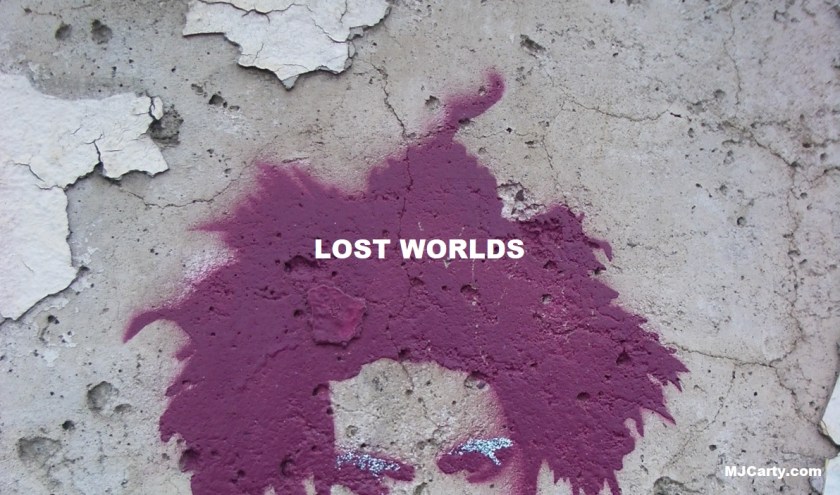
The Cure’s Robert Smith and thoughts of lost worlds. If you are lucky enough to live long enough, the world you cherish will become a lost world to you.
Self-doubt. Imposter syndrome. Nostalgia. Three imaginary feelings that are all too common, and each of which has its pitfalls.
If you are lucky enough, you might live long enough first to experience these feelings, then to come to terms with them. But if you should ever get to that point, you might also find that the world you thought you knew has changed beyond all recognition along the way. How do you come to terms with that?
I’ve been thinking about these feelings after hearing Robert Smith of The Cure talk about them in an extended interview posted online this month, in the run-up to the new Cure album Songs of a Lost World.
A world all their own
I am a lifelong admirer of Robert Smith (or at least, I have been an admirer of his since I was a teenager, which is now longer ago than the entire lifespans of some souls). In the sixth form at my school, the music fans of the more indie persuasion tended to be split between a devotion to The Smiths or The Cure. The Smiths seem an odd choice now, as they’d already been an ex-band for two or three years by that point. I was never a Smiths fan.* It was The Cure for me.
The Cure created a world all their own. A world that was and is a manifestation of sorts of Robert Smith’s mind. The Cure’s music and lyrics beckoned you into a wonderful, surprising, wildly diverse and atmospheric world. They had a distinctive visual style – a style which many others took as their own. Indeed, a school friend told me back then that he was only able to chat up and sometimes even kiss girls at parties if he went dressed in his version of the tatty jumper, backcombed hair and smeared make-up of Robert Smith. That friend from back then is sadly no longer with us. Those days feel a lifetime ago, a lost world.
Robert Smith always seemed to be speaking my language. The first new Cure release after I became a fan was 1990’s remix album, Mixed Up.** I remember relishing Smith’s interviews around the record’s release, which I believe was near Halloween. Around that time, I listened closely to his one-off takeover of Radio One’s Evening Session programme (rebranding the station “Radio Cure FM”). I always thought Robert Smith was something of a kindred soul. At university, someone who had somehow met Robert Smith the previous night*** told me that my speaking voice was very similar to his. I doubt that is true. But if there is a hint of truth to it, I would be flattered.
Listening to Smith’s 2024 interview this past week, it was heartening to learn that while so much has changed over the years, his innate humility, his honesty, humour and direct, clear wisdom would all appear undimmed. His unflappable convictions remain firmly in place. I refer you to his recounting of the stance he took in recent years against the high fees charged by Ticketmaster, wearing them down through sheer bloody-mindedness.****
Smith’s humility shines through in this interview. It is there in his talk of self-doubt, which is a constant in The Cure’s lyrical themes, and which has arguably prevented him releasing a lot more music over the years. It is also present in his owning up to feelings of imposter syndrome. Smith expresses disappointment in himself for declining many musical collaborations over recent years. He says that this was due to a conviction that he would let down his prospective collaborators. You have to wonder if this is overthinking things, and indeed thinking himself into a blind alley. I cannot speak for the unnamed musicians who missed out on the chance to collaborate with Robert Smith. But I would hazard a guess that they would treasure and be inspired by even the chance to interact and make music with him. The results would more than likely have been terrific, too.
Everyone in history

The Cure’s Songs of a Lost World is due for release on Friday 1 November 2024. Smith is somehow 65 years of age. It seems that he would have it no other way. But he is nonetheless aware of both his age and his mortality. He speaks in detail about the album’s themes, which touch on ageing and the feeling that the world of his youth is lost. Drone:Nodrone is a song inspired by an incident a few years back in which someone flew a drone over his garden. Smith says that the song’s lyrics track the feelings he went through in response to this incident. First, fury that the modern world should create an invention enabling such an invasion of privacy. But this fury gave way to other feelings, Smith explains:
“It ended up being about me coming to terms with my own reaction to it. How I’m kind of becoming an old grouch. It’s very easy to tip over into the fond memories of a world I think is rapidly disappearing or has already disappeared. Which has happened to everyone in history.”
Smith’s words reminded me of something wonderful I read a few months back, from the pen of a filmmaker from an earlier generation than Smith’s, Mr William Friedkin. Towards the end of his autobiography The Friedkin Connection, he shares some wise words about self-doubt, the traps of nostalgia, and also the universal leveller that is the passage of time. Friedkin says:
“I don’t fall into the misguided trap of thinking that my generation made masterpieces, and today’s filmmakers are marking garbage. That’s what old Hollywood said about the films of my generation.
“Just when you learn how to do it, you’re too old. Except in your dreams.”
Everyone of every generation, everyone in history, will likely have had to face times when they felt some degree of self-doubt. If they have had the gift to live long enough, combined with the privilege of time to reflect, they might well also have felt some sense of nostalgia for the lost world that was their youth.
If you are lucky enough to live long enough, the world you cherish will become a lost world to you.
Life’s opposite is an unavoidable part of life. Loss is an unavoidable part of life. Nobody can avoid these things. How you come to terms with them is up to you.
May you be nothing but kind today, to others and to yourself.
May today be nothing but kind to you and yours.
FOOTNOTES
* In the unlikely event that you want to know more about why I don’t like The Smiths before, it’s time the tale were retold (from my footnote to The moment summer ended):
Gentle reader: Please permit me a musical confession. I’ve never liked The Smiths. Way back in my sixth form days, those who were true music fans seemed divided into two broad camps: Smiths types and Cure types. I was and am most assuredly in the latter category. Nonetheless, I got to hear probably every single Smiths song and every Morrissey solo “joint” up to that point through my Smiths-loving friends (even to the extent of being more well-informed than I’d like to be of the then-raging debate as to whether Morrissey really is singing “It was a good lay” at the end of Suedehead. If you know the answer, please save yourself the bother of sending it to me on a postcard). For reasons I still can’t really fathom, I even accompanied my friends to see Morrissey live at Wembley Arena when he was touring the execrable Kill Uncle album. Potentially the most boring gig I’ve ever attended. I vividly remember two very excited blokes in front of me who were waving gladioli like crazy to Every Day Is Like Sunday turning round to ask why I wasn’t enjoying myself. Then again, is being the most miserable person at a Morrissey concert some kind of perverse badge of honour?
** I’ve always loved the Tree Mix of A Forest from Mixed Up. I’m sure I once read that this version is not so much a remix as an entirely new version, as the band were forced to rerecord the entire song, due to the original master tapes being in some way unusable or even lost. This version has a sleek, streamlined, space-y feel all its own.
*** I honestly can’t remember the name of this acquaintance from university. But she was a massive Cure fan, and was finally able to meet Robert Smith when she followed The Cure on their initial tour of (what were for them) smaller venues to promote 1992’s Wish album. I remember her telling me that she somehow made it backstage at one of these shows, and gifted Robert Smith a copy of Jean Cocteau’s Les Enfants Terribles – a gift with which Mr Smith was delighted, as he told her he’d never yet read it. She also said that she’d asked Robert Smith about what she took to be the sexual imagery in The Cure’s then brand-new song Friday I’m in Love. A confused Smith asked what she meant. She told him that she was referring to the line about “see[ing] you eat in the middle of the night”. Mr Smith set her straight, informing her that that particular lyric was actually about getting a late-night case of the munchies.
**** Smith argues in this interview that, in his opinion, major artists who say that their management makes all the decisions regarding ticket pricing and fees while they themselves remain blissfully unaware are either lying or “fucking idiots”.
IMAGES
- Robert Smith via Wikimedia Commons.
 MJCarty
